Bleeding gums are not normal, and ‘brushing too hard’ is rarely the reason
Almost everyone with bleeding gums has been told, or has told themselves, that they brush too hard.
Occasionally that is true. Usually it is not. Healthy gum tissue does not bleed under a soft toothbrush, in the same way healthy skin does not bleed when you wash it. If yours does, the tissue is inflamed, and the inflammation has a cause.
What is actually happening
Plaque, a soft bacterial film, forms on your teeth continuously. Within about 48 hours, the minerals in your saliva harden it into calculus, or tartar. Once that has happened, no toothbrush and no floss will remove it. It has to be scaled off.
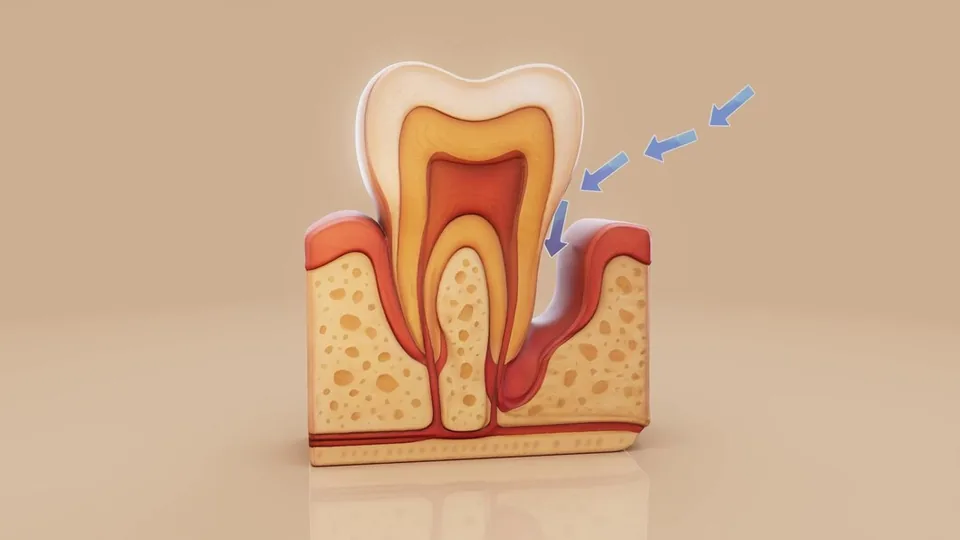
Calculus sits at and below the gum margin, holding bacteria against the tissue permanently. Your immune system responds with inflammation. Inflamed tissue is engorged with blood and fragile, so it bleeds at the slightest contact.
That stage is called gingivitis, and it is completely reversible. A professional cleaning plus consistent home care and the tissue returns to normal within a week or two.
Why it matters more than it seems
If the inflammation is left, it migrates below the gum line. The gum detaches from the tooth and forms a pocket, a space you cannot clean and where bacteria thrive. Now the immune response starts destroying the bone that holds the tooth.
This is periodontitis, and the critical thing about it is that it does not hurt. There is no toothache, no sensitivity, nothing that forces you to act. People notice when a tooth starts moving, and by then a substantial proportion of the supporting bone is gone.
Bone does not grow back on its own. Treatment at that stage arrests the process; it does not reverse it. This is why gum disease, not decay, is the leading cause of tooth loss in Indian adults.
The signs, in the order they usually appear
- Bleeding when brushing or eating something firm
- Persistent bad breath that mouthwash masks for an hour
- Gums that look red and puffy rather than pale pink and firm
- Gums receding: teeth start to look longer
- Black triangles appearing between the teeth
- A tooth that feels loose, or a bite that feels like it has changed
- Pus at the gum margin
Anything from point four onward means bone has already been lost. Points one to three are the window where this is cheap and completely fixable.
The diabetes connection
If you are diabetic, this section matters more than the rest.
The relationship runs both ways. Elevated blood sugar impairs the immune response and slows healing, making gum disease more severe and faster-moving. And established periodontitis raises systemic inflammation, which makes blood glucose measurably harder to control. Treating periodontitis in a diabetic patient improves their HbA1c.
Your gums are not a separate concern from your blood sugar. They are part of the same problem, and dentists and physicians should be managing them together.
What the treatment involves
Charting first. Pocket depths measured at six points around every tooth and recorded. This is the baseline that shows whether treatment is working. A cleaning without charting is a guess with no way to verify it. Insist on this.
Scaling and polishing for gingivitis. One appointment, 30–45 minutes.
Deep cleaning / root planing, priced per quadrant, where pockets have formed. Under local anaesthesia, cleaning below the gum line and smoothing the root surface so the tissue can reattach.
Reassessment at six weeks. Pockets re-charted and compared to baseline. Sites that have not responded are identified for surgery rather than cleaned repeatedly in hope.
Flap surgery for pockets that remain deep, sometimes with bone grafting where the defect shape allows regeneration. Both are quoted per quadrant after charting.
The scaling myth, addressed directly
Two things people believe, both wrong:
“Scaling removes the enamel.” It does not. Ultrasonic scaling breaks calculus off the tooth surface through vibration. Calculus is a deposit sitting on the tooth; enamel is the tooth. They are not the same material and the instrument does not cut enamel.
“Scaling made my teeth loose.” The calculus was splinting slightly mobile teeth together, and the swollen gum was hiding recession that had already occurred. Removing it reveals the state your mouth was already in. Leaving tartar in place to hold teeth in position is not a treatment plan. It is the disease progressing while you feel reassured.
What to do about it
Get scaled every six months. Every three to four months if you smoke, chew tobacco, are diabetic, wear braces, or have had periodontitis before.
At home: brush twice daily for two minutes with a soft brush at 45 degrees to the gum line, and clean between the teeth daily with floss or interdental brushes. Brushing alone misses roughly 40% of each tooth’s surface, and the areas it misses are exactly where gum disease starts.
And if your gums are bleeding right now, do not stop brushing that area because it bleeds. That is the instinct, and it is exactly backwards. Clean it gently and consistently, and see a dentist. The bleeding will settle as the inflammation does.